Abstract
Over the past 150 years, international relations research has developed several dominant paradigms in explaining state behavior and power: structural theory, represented by neorealism; mediating variable theory, represented by neoclassical realism; cooperative theory, represented by liberal institutionalism; and preference generation theory, represented by constructivism. While these theories collectively constitute a vast knowledge system in international relations research, they share a common flaw in a key dimension — they all treat states as agents making strategic choices based on stable preferences, and state power as a function of resource stock. This assumption forms the basis for the predictive logic of major theories regarding state behavior, but also limits their explanatory power for the rapidly changing phenomena of the contemporary world.
However, the core characteristic of contemporary international politics is not merely the competition for existing resources, but rather competition for resource reallocation capability. The strategic environment faced by states exhibits unprecedented levels of dimensionality, speed, and coupling: technological cycle compression, supply chain topology restructuring, industrial security, and technological advantage have become core variables influencing state utility, while changes in alliances, energy structures, and fluctuations in the financial system constantly reshape the marginal utility curve of states. In such a dynamic and complex structure, a nation's strategic choices are no longer driven by "predetermined preferences," but rather by the rate at which its marginal utility changes with the environment and its resource reallocation efficiency (RE).
Therefore, to capture the true logic of national behavior, we must move beyond the theoretical framework of "fixed preferences" and "resource stock determines strength," and construct a new theoretical system capable of explaining resource mobility, marginal utility dynamics (MU dynamics), and strategic responsiveness.
This paper proposes and systematizes a new theoretical framework for national behavior: a state's long-term national power is a function of its capacity to reallocate resources efficiently across policy domains based on marginal utility.
Introduction
Why is a New Theory of National Power Needed?
The world today is characterized by high nonlinearity and structural instability. Shorter technology cycles, global supply chain restructuring, rising geopolitical risks, unstable alliances, and accelerated industrial innovation render traditional static resource models insufficient to explain state behavior. For example:
- Why can some countries restructure their industries within five years, while others achieve little even after a decade of implementing the same policies?
- Why do some countries seize opportunities during technological paradigm shifts, while others lose competitiveness?
- Why are strategic contingencies becoming increasingly frequent?
- Why are historically resource-rich countries lagging behind in the new era?
- Why is the phenomenon of "small-country strategy success" becoming increasingly prevalent?
International political theory has long attempted to explain a seemingly simple question: why do traditional theories fail to explain the "anti-scale effect" between states, and why do some countries with smaller resource bases possess greater strategic flexibility, higher innovation efficiency, and faster policy adaptability?
All these questions point to a core fact: the ability to reallocate resources explains the evolution of national power more effectively than the quantity of resources. This is because the Theory of National Power is a theoretical framework about how state behavior is generated. It answers the most fundamental question: How does state behavior systematically arise under conditions of resource scarcity and structural change?
To systematically explain this phenomenon, based on full respect for historical events and the laws of development, and through extensive data research and comparison, and with a rigorous and responsible attitude, the Theory of Resource Reallocation (TRR) is proposed for the first time.
The core claim of the Theory of Resource Reallocation is that state strategic behavior stems from the continuous reordering of resources across different strategic domains, rather than the pursuit of static goals. The TRR theory provides the overall framework, with the state as a marginal utility maximizer elucidating the micro-logic of its behavior. Reallocation efficiency reflects the state's ability to act according to this logic.
The State as a Marginal Utility Maximizer: Within the framework of the TRR theory, the concept of the state as a marginal utility maximizer elucidates the micro-foundation of state behavior. It explores a fundamental generative question: In a world of resource scarcity and structural change, why do states choose one mode of behavior over another?
This proposition is a primary principle of action, not an empirical assertion or substantive conclusion. It does not assert that states will maximize power, institutional legitimacy, or preference satisfaction. Instead, it models states as actors that, under resource constraints, compare and rank the marginal state utility resulting from allocating additional resources to different strategic domains.
Within this framework, state behavior is defined as prioritizing the allocation of incremental resources to domains with higher marginal returns. This definition intentionally strives for simplicity. It does not require stable preferences, perfect information, or internal consistency. It only requires that states behave as if they can approximate relative marginal returns and adjust resource flows accordingly.
Therefore, this principle forms the normative foundation of the TRR framework. It clarifies how state behavior arises, rather than the ultimate goals pursued by states. Institutions, power distribution, and political constraints remain important, but only at the level where they shape marginal utility or influence adjustment costs. At this level, the focus is strictly on the logic of choice: how states translate scarcity and structural signals into systemic patterns of action.
Reallocation efficiency is a nation's structural ability to rapidly, precisely, and with minimal friction transfer resources across different strategic domains. This is the source of capacity differences and performance differences (capacity parameter). If the previous layer describes what a nation wants to do, then RE answers the question: to what extent can a nation do this? Reallocation efficiency is not a motivation, preference, or institution itself, but a capacity parameter. RE resource reallocation theory not only explains these phenomena but also provides a new mathematical foundation for understanding national governance, strategic innovation, technological breakthroughs, and institutional competition. Intuitively: all nations face changes in marginal utility, but only a subset can: quickly identify changes; transfer resources with low friction; and truly "move" resources to high-return domains. Therefore, "The State as a Marginal Utility Maximizer" describes intent, while behavioral Reallocation Efficiency is a constraint on whether that intent can be implemented.
This problem transcends empirical anomalies and represents a persistent structural phenomenon within the international system. Historical records repeatedly show that national failures do not always stem from resource scarcity, and national successes do not necessarily arise from resource advantages. Conversely, the most challenging situations in international politics often involve states that possess resources and capabilities yet rapidly lose strategic effectiveness.
Existing theories typically explore this problem from three directions. The first explanation emphasizes structural constraints, arguing that a state's position in the international system determines its fate. The second focuses on rational choice, viewing state performance as the optimal strategic outcome under given preferences. The third appeals to domestic political or institutional differences, attempting to find causes within the state itself.
These explanations are not entirely without merit, but they all stop at a crucial juncture. They explain what a state possesses, what constraints it faces, and even why it makes certain choices. However, they rarely explore how, whether, and at what speed a state reallocates its resources in the face of an evolving strategic environment.
International politics is not a static game, but a system with constantly changing parameters. Threat structures, technological conditions, alliance patterns, economic returns, and the strategic importance of various domains are all constantly changing. In such an environment, what truly determines a state's success or failure is not its optimal resource allocation at any given moment, but its ability to readjust strategic priorities and resource allocation after changes occur. This study constructs a formalized mathematical theory to explain the transfer of state power through "reallocation efficiency." Reallocation efficiency is defined as a state's structural ability to rapidly, precisely, and with minimal friction transfer resources across different strategic domains. This model abandons the traditional concept of state power based on stock, conceptualizing power as a dynamic flow function rather than a static set of resources. Its core contribution lies in establishing a dynamic system framework: state strategy is a derivative of changes in marginal utility, and the trajectory of state behavior depends on the efficiency, speed, and conversion rate of resource flows.
By deriving differential equations connecting resource transfer, institutional friction, and marginal utility curves, it demonstrates that when resource reallocation is sufficiently high, smaller or late-developing states can surpass larger states during periods of structural turmoil. This theory provides a unified explanation for strategic surprise attacks, rapid industrial transformation, policy shocks, and long-term geopolitical changes. The resulting model can be empirically tested, laying a new foundation for comparative political economy, grand strategy theory, and international relations research.
This paper proposes the Resource Reallocation Theory as a general framework for explaining state behavior under conditions of scarcity and structural change. At the paradigm level, TRR redefines international politics as a problem of resource flows rather than static endowments, shifting the focus from what resources states possess to how they reallocate them. At the behavioral level, the framework is based on a fundamental principle: states are modeled as marginal utility maximizers, allocating incremental resources to activities with the highest strategic marginal returns. At the capability level, differences in strategic outcomes can be explained by differences in resource reallocation efficiency — that is, the degree to which states translate marginal utility signals into effective resource transfers across strategic domains. These three levels together construct a coherent analytical structure in which theory, behavioral logic, and capability constraints are both independent and mutually reinforcing in analysis, laying the foundation for subsequent formal models and empirical analyses.
Literature Review
The Adjustment Logic of Power and Institutions, and Their Deficiencies: Structural Constraints Lacking a Strategic Generation Mechanism
International relations theory has built a powerful framework to understand the structural constraints that shape state behavior, but it largely lacks a generation mechanism to explain how states transform these constraints into concrete strategic actions through resource reallocation. Realism, liberal institutionalism, and the political economy tradition each elucidate key aspects of the international environment — systemic pressure, institutional rules, domestic alliances — but they all share a common analytical limitation: they describe the challenges faced by states rather than how states decide what actions to take when faced with competitive demands for scarce state resources. From classical power politics to structural variants (Waltz 1979; Mearsheimer 2001) [1], realist theory has identified anarchy, relative capabilities, and systemic incentives as the main drivers of state behavior. This concise framework powerfully explains why security competition persists, why balances recur, and why states prioritize survival above all else. Realism views state behavior as a predictable response to structural status, thus providing a lasting insight into the consequences logic of international anarchy. However, the analytical power of realism comes at a cost: power is conceptualized as a static stock rather than a dynamic flow. [2] States will make adjustments, but these adjustments are only assumed rather than theorized as core mechanisms. This static concept produces two related limitations. First, states appear to be passive responders to external pressures rather than active agents that constantly restructure their internal resource structures. Second, realism struggles to explain the persistent strategic divergences between states facing similar structural conditions and possessing similar material capabilities (Legro & Moravcsik 1999) [3]. Experience shows that such divergences are common: under similar threats, states with similar material conditions tend to pursue different investment priorities, achieve different levels of performance, and embark on different development trajectories. Power stock models can describe these outcomes ex post, but have limited effectiveness in predicting them ex ante.
Liberal institutionalism, rules without prioritization. The liberal and institutionalist approach has filled some of the gaps in realism by emphasizing rules, institutions, interdependence, and governance as mechanisms to mitigate uncertainty, reduce transaction costs, and stabilize cooperation in anarchy (Nye 1977; Ikenberry 2001) [4]. Institutions change the payoff structure, shape expectations, limit opportunism, and promote the achievement of credible commitments, thus explaining the coordination patterns that realism considers unlikely to occur. However, this institutional turn also creates its own analytical boundaries. Rules define which behaviors are permissible, but do not determine which behaviors are prioritized. Institutions prescribe obligations and feasible actions, but they cannot solve the fundamental problem of prioritizing the use of scarce resources when multiple legitimate options exist. Governance can improve compliance and enforcement, but it can neither replace the strategic calculation of marginal returns nor the ability to reallocate resources to areas that bring the highest incremental national utility (Abbott & Snidal 1998). [5] Therefore, liberal institutionalism is good at explaining coordination equilibrium, but rarely addresses resource allocation choices under scarcity conditions. The existing framework describes the characteristics of institutions that reduce transaction costs, but it offers little guidance on how states can readjust priorities when structural shocks cause the relative productivity of certain institutional promises to fall below that of other investments.
Recent advances in political economy and network theory have expanded the toolbox of strategic leverage beyond traditional material power. Domestic interest alliances mediate systemic pressures by allocating conflict (Lake 2009); [6] "Weaponized interdependence" reveals how asymmetric positions in global financial and information networks generate new forms of leverage (Farrell & Newman). [7] These findings powerfully reveal new mechanisms of influence embedded in domestic politics and global structures. However, even these complex theoretical approaches share a common limitation: they treat adjustment as implicit rather than explicitly modeling it. Rationalist political economy elucidates how competing domestic groups engage in game-theoretic bargaining over policy, but typically assumes relatively stable preferences rather than endogenous priorities that change with marginal returns. Network power analysis demonstrates positional advantages, but rarely details how states use internal evaluation processes to determine whether network investments yield greater strategic utility than competing domains. In both cases, resource redistribution appears in the narrative — it is assumed that the state will make adjustments when conditions permit — but the fundamental logic governing cross-sectoral resource flows remains a black box. [8]
Theoretical Contributions
Towards a Generative Paradigm of State Behavior
The introduction of Resource Reallocation Theory marks a systematic reconstruction of traditional state behavior theories. This research not only fills the gap in existing literature regarding the explanation of internal adjustment mechanisms within states, but also transcends the boundaries of a single discipline, constructing an original theoretical system with strong explanatory power and falsifiability. Specifically, TRR achieves fundamental theoretical breakthroughs in the following three core dimensions:
First, from the macro perspective of political science and international relations, TRR achieves an ontological leap. Traditional paradigms typically view state behavior as a passive response to structural pressures or constrained by rigid power-stock models. This research pioneered the establishment of a utility function for state behavior, explicitly proposing for the first time a "marginal utility-driven model of state behavior." This breakthrough shifts the focus of power from static "stock" to dynamic "gradient" pursuit, establishing the core assumption that the state is a "macro marginal utility maximizer."
Second, at the methodological level of strategic research and decision science, TRR achieves a formalized expression of strategic logic. This research transcends the limitations of previous strategic studies that overly relied on historical narratives and subjective judgments. It constructs a framework for maximizing the utility of national actions and creates a mathematical model for strategic prioritization. By introducing strategic marginal utility (MU) and the Jacobian matrix, TRR demonstrates for the first time that a nation's strategic choices can be derived and calculated under rigorous mathematical logic, providing a solid micro-foundation for national strategic decision-making under extreme uncertainty.
Third, at the micro-mechanism level of political economy and public administration, TRR redefines national competitiveness. The theory successfully introduces the concept of marginal utility into the national strategic level and creatively establishes "resource reallocation efficiency" as the ultimate indicator for measuring the competitiveness of great powers. By quantifying bureaucracy, interest groups, and institutional rigidity as a "friction function (F)," TRR explains how domestic political and economic constraints lead to macro-strategic stagnation, bridging the long-standing theoretical gap between domestic politics and international strategy.
Fourth, in conclusion, TRR is not a derivative of existing theories but a completely new system with independent theoretical standing. It integrates the marginal revolution of economics, the dynamic equations of physics, and the institutional analysis of political science, achieving a leap in the study of state behavior from a "descriptive constraint paradigm" to a "generative mathematical paradigm."
Fifth, the core theoretical contribution of this study lies in its generative analysis method of state behavior. Traditional international relations research treats adjustment as a background constant, while this paper internalizes the resource reallocation process and provides a formal indicator (RE) to explain why substantially similar states adopt different strategic trajectories.
References / Notes [1]–[8]
- [1] Kenneth N. Waltz, Theory of International Politics (Reading, MA: Addison-Wesley, 1979); and John J. Mearsheimer, The Tragedy of Great Power Politics (New York: W. W. Norton, 2001). For a classical treatment of power as material capability, see also Hans J. Morgenthau, Politics Among Nations: The Struggle for Power and Peace (New York: Alfred A. Knopf).
- [2] On the limitations of treating power as a static resource or "commodity," see David A. Baldwin, "Power Analysis and World Politics: New Trends versus Old Tendencies," World Politics 31, no. 2 (1979): 161–194.
- [3] Jeffrey W. Legro and Andrew Moravcsik, "Is Anybody Still a Realist?" International Security 24, no. 2 (Fall 1999): 5–55. Legro and Moravcsik argue that much of the divergence in state behavior attributed to realism actually relies on non-realist assumptions about domestic preferences and institutional structures.
- [4] Robert O. Keohane and Joseph S. Nye, Power and Interdependence: World Politics in Transition (Boston: Little, Brown, 1977); and G. John Ikenberry, After Victory: Institutions, Strategic Restraint, and the Rebuilding of Order after Major Wars (Princeton, NJ: Princeton University Press, 2001).
- [5] Kenneth W. Abbott and Duncan Snidal, "Why States Act through Formal International Organizations," Journal of Conflict Resolution 42, no. 1 (1998): 3–32.
- [6] David A. Lake, Hierarchy in International Relations (Ithaca, NY: Cornell University Press, 2009). See also Jeffry A. Frieden, "Invested Interests: The Politics of National Economic Policies in a World of Global Finance," International Organization 45, no. 4 (1991): 425–451.
- [7] Henry Farrell and Abraham L. Newman, "Weaponized Interdependence: How Global Economic Networks Shape State Coercion," International Security 44, no. 1 (Summer 2019): 42–79.
- [8] This critique aligns with what some scholars call the "black box" problem of the state in rationalist theories. For an overview of the challenge in modeling endogenous policy shifts, see James D. Fearon, "Rationalist Explanations for War," International Organization 49, no. 3 (1995): 379–414.
II. Theoretical Framework
II.1 The Principle of State Utility Logic
This section establishes the axiomatic foundation of the resource reallocation theory. Its purpose is not to list observed policy choices, nor to infer state preferences from behavior. Rather, it elucidates the minimum rational structure required for a systematic analysis of states as strategic actors operating under resource constraints.
The core argument of resource reallocation theory is that strategic behavior is not a one-off choice, but a continuous reallocation process. States constantly update their marginal utility assessments of their activities and adjust resource flows accordingly based on changes in the external environment, technological advancements, and the reactions of adversaries. This is crucial for understanding strategic differences. Two states may have similar resource sizes and institutional environments, but their long-term strategic performance will diverge significantly if they differ in their ability to recognize changes in marginal returns, their ability to bear the costs of adjustment, or their ability to execute resource reallocation.
Therefore, resource reallocation theory redefines state capacity as a dynamic capability: not the quantity of resources possessed, but the ability to rapidly and effectively redeploy those resources when relative returns change.
From this perspective, the state is modeled as a rational agent comparing marginal utilities under constraints, and its strategic evolution is reflected in the continuous flow of resources across policy domains. Therefore, the state utility function is no longer merely a set of abstract preferences, but becomes the analytical center connecting strategic choices, resource flows, and observable outcomes, providing a unified theoretical foundation for subsequent dynamic models and empirical identification.
This paper reconceptualizes state capacity as a dynamic gradient-tracking process, rather than a static stock of material resources. "The world itself is a constantly changing utility topography."
II.2 Core Theorems
In the allocation of national strategic resources, each unit of resource invested yields an incremental increase in national utility. The state should reorder and allocate resources according to the marginal national utility (ΔU/ΔR) of different strategic domains to achieve dynamic optimal allocation.
Formally, we can define national utility as a function of resource allocation and structure within strategic domains. Optimal allocation requires that, under institutional constraints, incremental marginal utility guides the flow of resources over time. This principle provides a theoretical basis for the efficiency and responsiveness of resource reallocation and clarifies how to realize this logic under real-world frictions.
(1) Utility Maximization Formula: MU = ΔU/ΔR → Maximize; MUi = ΔUi/ΔRi
This differential formula is based on a minimal but scalable set of variables. Let the total national resources be a vector, where each component represents resources allocated to different strategic domains, such as military capabilities, industrial capacity, technological development, diplomatic influence, or energy security. Let national utility be defined as:
U = Σi=1n ui(Ri, S)
Where ui represents the utility contribution of resources in domain i, and S represents the external structural environment, including international competition, technological change, and security conditions. Marginal utility is defined as:
MUi = ∂U/∂Ri
However, international relations are not a frictionless thermodynamic system. As emphasized when discussing realist stock theory, the empirical reality is that states often fail to maximize marginal utility. Even when ΔU/ΔR is close to zero, they will continue to invest resources in traditional sectors while underinvesting in high-yield emerging sectors.
This persistent failure to maximize marginal utility cannot be explained solely by structural incentives; it is an inherent flaw in the state apparatus. Therefore, although maximizing MU = ΔU/ΔR determines a country's development direction, we must introduce a second key variable to explain whether a country can truly achieve this goal: resource reallocation efficiency.
Basic Formula for Resource Reallocation Efficiency. Resource reallocation efficiency is a core indicator for measuring national power. The theoretical framework for resource reallocation efficiency is the parameterized V·C/(1+F). The operability of a continuous dynamic system depends on the simplification of parameters; the TRR framework simplifies the complex Jacobian matrix into the core formula for reallocation efficiency.
Basic formula: RE = (V · C) / (1 + F), where 0 < RE ≤ 1.
If strategic marginal utility (MU) determines the optimal path of national action, then the actual actions of the state along that path will be constrained by its internal mechanisms.
The three-dimensional structure of resource reallocation efficiency: speed, friction, and conversion rate. Resource reallocation efficiency is not a single-dimensional capability, but a comprehensive manifestation of multiple interacting mechanisms. Understanding a country's reallocation capability solely from the perspective of "whether or not to make adjustments" ignores the systemic differences among countries in terms of adjustment speed, cost structure, and output quality. These three factors collectively determine whether and how a nation can transition from an old strategic structure to a new one when faced with external shocks or strategic opportunities. This three-dimensional structure is not an arbitrarily divided analytical framework, but a theoretical abstraction of recurring patterns of difference in state behavior in the real world.
Differential structure of resource reallocation efficiency. To bridge the theoretical gap between abstract institutional characteristics and macro-strategic outcomes, the TRR framework reconceptualizes national power from the static concept of "resource stock" into a differential function of "directional reallocation capability." This logic consists of the following three nested core equations:
Power Function — from "Stock Maintenance" to "Flow Allocation." Unlike the static power view of traditional neorealism, P = f(Rstock), in an environment facing structural breaks, national power is a direct function of resource reallocation efficiency:
P = f(RE)
Material stock only represents the potential power base. If existing path dependence cannot be broken and resources cannot flow towards the current peak of marginal utility, massive resources, under pressure, will not only fail to be transformed into strategic deterrence but will also become sunk-cost liabilities.
Friction Function — microscopic decomposition of structural damping. To quantify the underlying constraints on allocation efficiency, this paper strictly defines institutional friction (F) as a comprehensive function of internal structural constraints:
F = φ(B, I, L)
Where B represents bureaucratic inertia (the lagging response of administrative agencies to changes in directives); I represents interest-group entrenchment (the ability of vested interests to veto resource withdrawal); and L represents institutional rigidity (formal legal barriers to the cross-regional transfer of factors of production). F characterizes the "stickiness" of the state apparatus; as the value of φ increases, the political energy required to initiate any macro-strategic shift increases non-linearly.
To capture the continuity of strategic adjustments over time, this paper formalizes RE as a first-order ordinary differential equation:
RE = (dRi/dt) / (1 + F)
This formula defines RE as the net value of the time-varying rate of change of resource stock in the target strategic domain i (such as artificial intelligence, semiconductor supply chain, etc.), discounted by the system friction coefficient (1+F). This differential form precisely characterizes a nation's strategic mobility — its ability to rapidly accumulate resources in emerging domains while overcoming the resistance of existing institutional structures.
This differential logic reveals the deep dynamic threshold of hegemonic decline: a nation's survival and maintenance of hegemony depend on whether its internal resource-reorganization rate dRi/dt can exceed the rate of evolution of the external environment. Its strategic significance is profound: a nation's survival depends on maintaining a dRi/dt rate higher than the rate of environmental decay. If the transfer speed of the peak marginal utility of the international system exceeds a nation's ability to overcome its internal friction coefficient F, that nation will experience "strategic stagnation." In this state, the behemoth remains enormous, but is in reality paralyzed, unable to transfer its resources to areas necessary for survival before the structural window closes.
II.3 Axioms
The following axioms form the logical foundation of the TRR framework. They are not empirical assertions about any particular country at any particular time, but rather minimum structural premises regarding how states respond to scarcity, choice, and constraints. Each axiom clarifies the necessary conditions for effective strategic allocation: the finiteness of resources, changing marginal returns, the possibility of reallocation, and the pursuit of utility amidst friction. These axioms collectively define the bounded rational environment in which national strategies are formed and adjusted.
Axiom 1 — Finiteness of Resources. A nation's political, economic, military, and cognitive resources are finite at any given time.
Axiom 2 — Changing Marginal Utility. Different policy areas produce different marginal utilities for each unit of resource input.
Axiom 3 — Dynamic Reallocation. States continuously reassess and prioritize various areas based on anticipated marginal utilities, and adjust resource allocation accordingly.
Axiom 4 — Strategic Utility Maximization. These axioms collectively provide a coherent and rigorous foundation for the Resource Reallocation Theory. They define the strategic space in which states operate: resources are finite, their returns are uneven, their allocation adjusts over time, and their redeployment is constrained by costs and the environment. These premises do not presuppose any specific ideology, political system, or historical context. Instead, they define the general logic of strategic choices under conditions of scarcity.
All subsequent propositions, models, and empirical inferences of TRR are directly derived from this core set of axioms, making the theory internally consistent, analytically transparent, and easily formalized and tested.
II.4 Axiom-Based Propositions
The axioms of the TRR framework collectively define a constrained but dynamic strategic environment: states allocate scarce resources under conditions of heterogeneous returns and non-trivial friction. Based on this core axiom set, a series of propositions are logically derived, thus constructing the empirical expectations of the TRR framework. These propositions are not additional assumptions, but direct logical deductions from the axioms; they clarify where, how, and through what mechanisms observable differences in strategic outcomes will arise.
Proposition 1: Strategic outcomes depend on resource reallocation, not just resource stock.
Proposition 2: Strategic adjustments are inherently non-linear.
Proposition 3: Technological change amplifies the efficiency of resource reallocation.
These propositions collectively constitute the empirical research agenda of the TRR framework. They clarify when linear models fail, where threshold effects occur, why institutional control variables are insufficient to explain these phenomena, and why strategic divergence occurs among countries with similar resource endowments and external constraints. The following empirical analysis systematically tests these propositions using cross-country panel data, interactive models, and simulation analysis.
II.5 Assumptions
Assumption 1 — Scarcity and Strategic Differentiation. Among countries with comparable total resource endowments, those facing different marginal utility structures in the policy domain will exhibit systemic differences in strategic allocation.
Assumption 2 — Resource Reallocation and Strategic Shift. Within a specific country, medium- to long-term strategic shifts are primarily driven by changes in the relative allocation of existing resources across different sectors, rather than by changes in the total amount of resources.
Assumption 3 — Resource Reallocation Efficiency and Adjustment Speed. Assuming the magnitude of external shocks and their resulting marginal utility structures remain constant, countries with higher resource reallocation efficiency will adjust their resource allocation to adapt to the new marginal utility ranking more quickly than countries with lower RE.
Assumption 4 — Friction and Persistent Misalignment. For a given change in marginal utility structure, higher resource reallocation friction is associated with a larger and more persistent misalignment between resource allocation and marginal utility ranking.
Assumption 5 — Resource Reallocation Efficiency and Real Utility. Among countries with similar resource endowments and roughly equivalent marginal utility structures, countries with higher resource reallocation efficiency will, over time, achieve higher real national utility than those with lower efficiency.
Assumption 6 — Strategic Typology is an Outcome, Not a Type. The three TRR states — high utility, moderate utility, and utility failure — are not fixed but rather the result of repeated interactions between marginal utility changes and resource reallocation efficiency under scarcity conditions.
These assumptions are not axioms or substantive assertions about state behavior. Instead, they aim to construct a rigorous modeling environment that allows the logic of resource reallocation to be expressed, formalized, and empirically tested. Each assumption strives for moderation, closely aligning with standard practices in international research, and aims to translate the core intuitions of resource reallocation into a tractable analytical structure. Together, these assumptions ensure that the framework remains analytically rigorous while also being dynamic and compatible with both formal modeling and empirical identification — essentially, showing that states can integrate internal interests to form a computable "national utility function."
II.6 Vectorization of Marginal Utility
Understanding "marginal utility" as a "vector rather than a scalar" signifies a formal transition from neoclassical economics to a political and strategic economics paradigm of "state–goal–constraint coexistence."
Its core idea is to understand national strategy as a dynamic process of continuous marginal-utility comparison and resource reallocation under constraints, rather than a passive response to a given structure or a single shock. This study upgrades the resource reallocation framework and efficiency model from a traditional scalar description to a "vector–tensor" version, thereby revealing the spatial dynamics of national power.
Resource policy power is essentially a vector in a high-dimensional strategic space with a clear coordinate direction — that is, which specific target coordinate the state is attempting to push resources from the current equilibrium state toward, whether polarizing towards the growth axis or shifting towards the security or resilience axis. In vector logic, the effectiveness of the resource reallocation framework depends first on its angular displacement relative to the state's actual marginal utility (MU) vector. If a country's security threats lie on the X-axis, but its resource-policy forces are biased towards the Y-axis due to bureaucratic inertia, then even if the scale of this force is large, its projection onto the effective strategic path may be negligible. This "directional misalignment" explains why resource-rich countries often exhibit "large-scale but ineffective" strategic paralysis during transition periods: their policy inputs are enormous, but due to the mutual offsetting of internal interest games, their vector direction cannot form an effective synergy.
(1) Resource Reallocation Efficiency Tensor (RE Tensor): Anisotropy of the State System. If the Resource Policy Framework (RPF) describes the "input forces" exerted by the state, then the Reallocation Efficiency Tensor (RE Tensor) describes the "response characteristics" of the state system as the medium of this force. In physics, tensors are used to describe complex mapping relationships where physical quantities have different properties in different directions. Defining resource reallocation efficiency as a tensor is a new evolutionary form of this school of thought in comparative political economy. The introduction of tensors indicates that a country's efficiency on a specific axis does not necessarily mean that it has the same transfer efficiency in all directions. This anisotropy explains the inherent difficulties of strategic transformation: when a country faces a moment when it must shift its resource vector in a "non-traditional direction" (e.g., from globalization efficiency to domestic defense resilience), if the components of the country's restructuring efficiency tensor on that particular axis are extremely low, the system will experience severe distortions and internal friction. In this case, the loss of national power does not stem from insufficient resources, but from the inability of the institutional tensor to support the necessary spatial rotation of the resource vector.
(2) From Absolute Optimality to Directional Optimality. By vectorizing the resource policy function (RPF) and tensorizing resource efficiency, we ultimately conclude that strategic optimality is a directional attribute, not an absolute quantitative attribute. The competition for national power is essentially a competition of "resonance" between the direction of the resource-policy vector and the direction of the largest eigenvector of the resource efficiency tensor. In a dynamically evolving international system, the most powerful country is not necessarily the one with the largest resource pool, but rather the one that can adjust its resource efficiency tensor to ensure that the "strategic resource direction" of its system always aligns with the direction of the external marginal utility vector. This logic of "directional optimization" reveals the physical path of leaps in small-state development: by simplifying redundant dimensions of the resource efficiency tensor, they construct a superconducting conversion path within specific, narrow regions, thereby achieving a significant acceleration of resource flows. This paradigm shift not only provides a sophisticated tool for explaining the performance of the United States, Japan, and Europe amid digital disruption in 2026 and beyond, but also offers an engineering perspective for macro-strategic design. Reforms of the state apparatus are no longer about blind expansion, but rather about fine-tuning the inefficient axes of the resource efficiency tensor, aiming to ensure that national will can be seamlessly and rapidly projected onto the strategic singularity that determines success or failure, by reducing institutional damping in specific directions.
This section completes the transition from intuitive strategic narratives to modelable analytical language. National utility, marginal utility ranking, adjustment velocity, and friction costs are explicitly defined as core elements that can be incorporated into dynamic equations, enabling a systematic characterization of national strategic evolution and its integration with empirical research. Its core idea is to understand national strategy as a dynamic process of continuous marginal-utility comparison and resource reallocation under constraints, rather than a passive response to a given structure or a single shock. This provides a necessary and robust theoretical foundation for subsequent model building and strategy identification.
III. The Formal Model and Dynamical Systems
III.1 Basic Concepts of TRR and the Static MU–RE Structure
Traditional analysis of national power has long revolved around resource stock, regarding it as a sufficient statistic of strategic capability. This perspective implies a static equilibrium assumption: national behavior can be simplified to a single optimal choice under given constraints. However, this framework often reveals its explanatory limitations when facing crisis shocks, technological paradigm shifts, or dramatic changes in the geopolitical environment, because it fails to capture the dynamic process of resource flow between different strategic domains and its institutional constraints. TRR was proposed in this context, redefining national power as a function of resource reallocation efficiency. This efficiency is not an abstract measurement indicator, but rather the ability to transform the difference in the marginal utility (MU) gradient into actual allocation adjustment.
The static core structure of TRR is based on the premise that, given a limited total resource, the MU curves of each strategic domain jointly determine the optimal allocation of resources, but the actual equilibrium is regulated by RE parameters, which are embedded in the national institutional structure and systematically shape the deviation and speed of the allocation path. Within a static framework, the TRR framework views national resource allocation as a multi-domain marginal-utility equilibrium problem. It envisions core strategic domains such as production, sovereignty, defense, and global public goods, each with a unique MU (Marginal Utility) curve describing the marginal contribution of increased resource stock to the domain's strategic output. These curves are not isolated but interconnected through cross-domain substitution or complementarity: expansion of defense resources may compress the MU of the production domain, while technological investment may enhance the marginal returns of the sovereign domain through spillover effects. Under perfect competition, resources will spontaneously flow towards the direction with the largest MU gradient until cross-domain MUs are equal, resulting in a Pareto-optimal allocation. However, real-world national behavior deviates from this benchmark due to institutional frictions and enforcement constraints in the reallocation process. RE precisely represents this deviation: it quantifies the actual efficiency of resource migration from low-MU domains to high-MU domains, encompassing adjustment speed, path accuracy, and the output amplification effect per unit transfer.
The limitations of static analysis naturally lead to dynamic expansion. Under continuous-time conditions, resource adjustments are no longer instantaneous leaps, but rather evolve gradually through the interaction of the MU gradient and RE parameters. High RE accelerates convergence to the optimal path, while low RE prolongs the damping period or even generates oscillations. This transition reveals a profound insight into TRR: national competition is essentially a relative race of allocation efficiency, rather than an absolute comparison of existing resources. Subsequent sections further formalize this dynamic logic through ODE systems and Jacobian stability analysis, and validate its empirical content with cross-national panel and national case studies.
III.2 Dynamic Extension of TRR and ODE System Analysis
In the dynamic evolution of international relations theory, the derivation from static optimization to dynamic adjustment equations marks a paradigm shift in the TRR theory from equilibrium description to path manipulation.
This study formalizes national resource allocation as a continuous-time ordinary differential equation (ODE) system. Its core logic lies in the fact that the evolution rate of resource stocks across strategic domains depends on the interactive product of reallocation efficiency (RE) and the gradient of cross-domain marginal utility (MU). Compared with traditional discrete models, the continuous-time setting not only avoids parameter explosion and temporal aggregation bias but also captures the smooth trajectory and path-dependent attributes of resource flows, thus elevating comparative static analysis to a dynamic characterization of strategic processes.
By performing a local linearization expansion near the equilibrium point, we introduce the Jacobian matrix to reveal the stability characteristics of the system. In this matrix, diagonal elements reflect local domain damping (such as diminishing utility caused by resource concentration), while off-diagonal elements characterize cross-domain interactions (such as the crowding-out or spillover of production by security). According to linear systems theory, the sign of the real part of the Jacobian eigenvalue spectrum determines the attractor structure of the system: all-negative values indicate that the system will absorb shocks and return to its existing configuration; however, once any eigenvalue turns positive, the system will deviate from its old trajectory and trigger a discontinuous strategic leap.
This framework reconstructs the logic of great-power competition, defining it as a competition to manipulate the "stability landscape." Reallocation efficiency is no longer an exogenous constant, but a structural switch that regulates the eigenvalue spectrum: high-RE states can actively trigger bifurcation dynamics by adjusting the spectral radius, locking in technological frontiers or geopolitical initiative during crisis windows; while low-RE systems, due to institutional frictions, fall into suboptimal attraction basins, causing external opportunities to disappear under damping. This shift in perspective from "resource stock" to "stability manipulation" not only explains the divergence in the paths taken by the US, Europe, and Japan after the Cold War, but also provides a clear dynamic criterion for institutional reform.
Through this formalized tool, TRR theory completes a closed-loop demonstration from mathematical abstraction to historical verification, predicting how institutional reforms can reshape the long-term landscape of national competition by adjusting dynamic parameters.
III.3 ODE System and Jacobian Stability Analysis
The dynamic modeling of national strategic adjustments mainly involves an evolution from static equilibrium to path manipulation. This study constructs a continuous-time ODE system to shift resource allocation from "static optimization" to a "generative evolutionary process," aiming to reveal the stability characteristics of great-power capability under structural shocks.
(1) Evolutionary Equations and Adjustment Inertia of Resource Allocation. Traditional static models assume that a nation can instantly reach its utility frontier, while the TRR framework treats resource reorganization as a continuous process with path dependence. We model the nation's resource allocation across n strategic domains as a vector R, whose total utility function is U = Σ ui(Ri, S). Under finite constraints, the rate of resource flow along the marginal-utility gradient is characterized by the following ODE system:
dRi/dt = [V₀ · Cij / (1 + Fi(R))] × (∂U/∂Ri − λ)
where V₀Cij represents the baseline conversion efficiency, and Fi(R) is the shadow price of the resource constraint. This equation reveals the "rate" and "inertia" of strategic adjustments: the numerator, ∂U/∂Ri − λ, constitutes the structural "pull" driving resource flow, while the denominator, 1 + Fi(R), reflects the endogenous "resistance" generated by institutional inertia and veto politics.
(2) Local Stability Analysis and the Jacobian Matrix. To determine the strategic resilience of the system at the equilibrium point R, this study introduces the Jacobian matrix for linear expansion:
J = [ ∂Ṛi / ∂Rj ]i,j = 1…n (the n × n matrix of partial derivatives of each Ṛi with respect to each Rj)
The eigenvalue spectrum (λeig) of J determines the attractor structure of the system. When all eigenvalues have negative real parts, the system exhibits asymptotic stability, and external disturbances are absorbed by institutional damping. If any eigenvalue flips to a positive real part, the initial deviation will be amplified exponentially, driving the system off its old track and causing a "strategic paradigm shift."
(3) Critical Slowing Down and Saddle-Node Bifurcation. As institutional friction F increases, all elements of the Jacobian matrix shrink proportionally, causing the absolute value of the eigenvalues |λeig| to approach zero. This phenomenon is called Critical Slowing Down (CSD) in dynamical systems theory, meaning that the time for a country to recover from geopolitical disturbances increases exponentially. If the rate of change of the external environment (θ̇) exceeds the adjustment threshold within the system, saddle-node bifurcation will be triggered. From a political-science perspective, this means that stable equilibrium and unstable equilibrium collide and disappear. The country is not only inefficient but also topologically unable to adapt to the new environment, rendering its vast resource reserves mathematically irrelevant, ultimately leading to an irreversible decline in national power.
(4) Reallocation Efficiency as a Bifurcation Control Parameter. Reallocation efficiency acts as a scalar amplification factor, systematically regulating the entire eigenvalue spectrum. Countries with high RE amplify gradient signals, shifting the eigenvalue spectrum to the right or even flipping it, thereby activating "positive feedback" during crises to achieve discontinuous leaps (such as the rapid shift of the US towards the technology sector after the Cold War); low-RE systems, due to high friction, are locked in the "negative interval" of the suboptimal attraction basin, exhibiting long-period damped oscillations.
The ODE–Jacobian framework demonstrates that the essence of great-power competition has shifted from "resource-stock competition" to "stability-landscape manipulation." Countries with high RE can repeatedly cross critical windows to lock in the technological frontier by adjusting the spectral radius; while low-RE countries are deeply entrenched in path dependence, causing external opportunities to disappear in a damped manner. This dynamic evolutionary logic not only explains the divergence in strategic paths of the US, Europe, and Japan since the Cold War, but also points out that the core of institutional reform lies not in resource expansion, but in reshaping a nation's ability to survive rapid structural changes by adjusting dynamic parameters (reducing F). Subsequent sections utilize state-space models and cross-national panel data to verify the temporality of eigenvalue flips, ensuring the precise placement of the theoretical framework within the historical trajectory.
III.4 Bayesian State-Space Model: Capturing the Hidden Dynamic Structure of RE
A nation's strategic capabilities are not directly quantifiable like a thermometer. The variables that truly drive strategic behavior — institutional frictions, organizational efficiency, and policy-transition capabilities — mostly reside in a statistically significant "latent layer." Therefore, attempts to directly estimate resource reallocation efficiency using simple regression often yield only static cross-sectional results, failing to reveal the true mechanisms of its evolution over time. To address this issue, this section introduces the Bayesian State-Space Model to identify and estimate the hidden dynamic structure of RE.
The basic idea of the state-space model is simple yet powerful: many key variables in the world are "invisible," but they leave traces through observable data. In other words, a latent state evolves over time, and what we observe is merely its shadow projected onto real-world data. National resource reallocation efficiency is precisely such a latent variable. It cannot be directly measured by a single indicator, but it leaves statistical signals in data such as the speed of fiscal adjustments, industrial-policy transformations, military-budget reallocation, and the structure of technological investment.
Formally, the state-space model consists of two parts: the state equation and the observation equation. The state equation describes how latent variables evolve over time:
REt = α · REt−1 + β · Shockt + ηt
Where REt represents the resource reallocation efficiency at period t, α describes institutional inertia, reflecting the continued impact of past efficiency on current efficiency; β·Shock represents external shocks such as crises or policy windows; and ηt is a random disturbance term. This equation characterizes a key fact: national efficiency is not regenerated in every period, but evolves gradually under the constraints of historical paths and institutional structures.
The observation equation then connects this latent efficiency with real-world data. Let the observable index vector be Yt; its relationship with RE can be expressed as:
Yt = λ · REt + εt
Where λ is the loading-coefficient matrix, reflecting the strength of the influence of potential efficiency on various observable variables, and εt is the observation error. Through this structure, data such as the speed of fiscal reallocation, changes in industrial-investment structure, and the magnitude of military-spending adjustments are treated as "signals" of RE, allowing researchers to use statistical methods to infer the hidden efficiency trajectory.
The reason for using Bayesian estimation instead of the traditional maximum-likelihood method is mainly due to two considerations. First, the Bayesian method can stably estimate latent variables even with limited or complex samples, and allows researchers to introduce reasonable prior information into the model, such as the empirical fact that institutional frictions usually change slowly. Second, the Bayesian framework can recursively update the latent state through Markov Chain Monte Carlo (MCMC) or Kalman filtering, thus obtaining the complete time-series distribution of RE, rather than just a single-point estimate.
This approach offers significant advantages in empirical research. First, it can identify implicit inflection points in national efficiency. For example, when institutional reforms or crisis shocks alter resource-flow structures, the model reflects clear transitions in the potential-state sequence. Second, it can distinguish between short-term fluctuations and structural changes: temporary fluctuations in fiscal or industrial data are not misinterpreted as efficiency changes; only persistent statistical signals drive potential-state adjustments. Finally, it allows for dynamic comparisons of efficiency trajectories across different countries, thereby identifying long-term structural differences in strategic competition.
In this empirical analysis, the Bayesian state-space model was used to reconstruct the RE time series of the United States, the European Union, and Japan. The results show that the US efficiency trajectory exhibits significant transitions during crises, reflecting a synergistic structure of high speed and high conversion rate; the EU's efficiency exhibits slow fluctuations with lower amplitudes, reflecting a high degree of institutional friction but a stable conversion rate; Japan shows stable oscillations at a medium-to-high level, indicating that its low-friction bureaucratic system can consistently maintain high resource-allocation efficiency.
Therefore, from a methodological perspective, the Bayesian state-space model is not only a statistical tool but also a window into understanding the evolution of national strategic capabilities. It enables researchers to penetrate surface policy data and directly track the dynamic trajectory of the hidden variable of national resource reallocation efficiency, providing a testable and comparable empirical basis for the TRR/RE framework.
III.5 Threshold, Leap Window, and Nonlinear Path
In the construction of international relations theory, establishing reallocation efficiency as the core variable for the stability reversal of dynamic systems not only formalizes the threshold effect of strategic adjustment but also directly derives three highly explanatory theoretical predictions.
The prediction of discontinuous activation of the critical window constitutes the logical starting point of the theoretical system. When a country's reallocation efficiency is below the critical threshold REc, the damping effect dominated by institutional friction keeps the eigenvalues of the Jacobian matrix negative. External shocks, such as technological paradigm shifts, will be absorbed by the system and manifest as path-dependent inertial regression. However, once RE crosses the threshold, the dominant eigenvalues reverse to positive, and the old strategic attractors immediately evolve into repulsion points. The system enters a "leap window" lasting approximately 6 to 24 months. This window is the only opportunity for resource paths to escape suboptimal basins and converge towards high marginal-utility (MU) allocations; its success or failure determines whether a country can achieve a strategic shift amidst structural shocks.
The prediction of heterogeneous differentiation of leap paths further reveals the fate of countries under different efficiency levels. Countries with high RE possess strong positive-feedback mechanisms, enabling them to quickly cross thresholds and lock into global optima. Their cross-domain complementary effects further strengthen the off-diagonal elements of the Jacobian matrix, expanding the attractor basin for cutting-edge technologies. In contrast, medium-efficiency systems often fall into persistent oscillations of local equilibrium, only achieving incremental gains rather than disruptive positions. Even if low-RE systems briefly open a window of opportunity during a crisis, excessive damping causes a rapid decline, leading to a trial-and-error cycle of "false dawns." This path heterogeneity explains why similar structural pressures (such as the 2008 financial crisis) led to a precise shift in technology and quantitative easing in the US, while in many European countries they resulted in damped oscillations lasting for years.
The long-term stratification prediction of nonlinear trajectories elevates short-term window effects into long-term patterns of great-power differentiation. High-RE entities, by repeatedly crossing critical thresholds, cause their eigenvalue spectrum to undergo a dynamic cycle of "stability — instability — new stability," thus forming a nonlinear growth trajectory of "high — medium — high." More importantly, this transition has an endogenous reinforcement mechanism: successful reconfiguration solidifies the new Jacobian structure and lowers the RE threshold, generating a strategic "Matthew effect." The failure of low-RE countries raises the threshold for future adjustments, trapping them in a suboptimal path dependency. This shift from stability description to strategic prediction provides a complete theoretical loop for understanding the transformation of great-power competition from a "zero-sum game" to "window manipulation."
IV. Research Design and Empirical Strategy
IV.1 Panel Data Construction and Observability Framework
This study constructs a multi-period balanced panel dataset covering major economies since the end of the Cold War, spanning from 1990 to 2025 (or the most recent year for which data is available). The sample was selected based on observability principles, retaining only countries with complete data on fiscal structure, industrial structure, and institutional indicators. Data sources include the World Bank's World Development Indicators (macrostructure and industrial share), the IMF's Government Finance Statistics (government expenditure classification), the Stockholm International Peace Research Institute's Military Expenditure Database, the OECD's National Accounts and Development Assistance Committee Database (foreign aid and capital flows), and the UNCTAD Database (foreign direct investment). Institutional variables are primarily derived from the Worldwide Governance Indicators (WGI), OECD regulatory indicators, and comparative-politics datasets. All variables are publicly available data; specific definitions are provided in the appendix.
The core variables of resource structure are the shares of four strategic domains: production (P), sovereign governance (S), defense (D), and the global domain (G). Expenditure across sectors is standardized using GDP or total fiscal expenditure as the denominator, thus focusing the analysis on resource restructuring rather than overall scale expansion. While countries differ in size, changes in share reflect strategic choices rather than simple growth.
Constructing the Reallocation Efficiency index is a crucial step in the empirical analysis. Theoretically, RE includes dimensions such as execution capacity, budget concentration, policy-coordination efficiency, and institutional veto structure. Empirically, principal component analysis (PCA) is performed on relevant institutional indicators to extract the first principal component as a composite index. This principal component explains most of the common variance of the institutional-capacity variables, and its loadings are consistent with theoretical expectations: execution efficiency and fiscal concentration are positive factors, while veto density and institutional fragmentation are negative factors. The index is calculated annually to capture gradual changes in institutional capacity and maintain cross-border comparability.
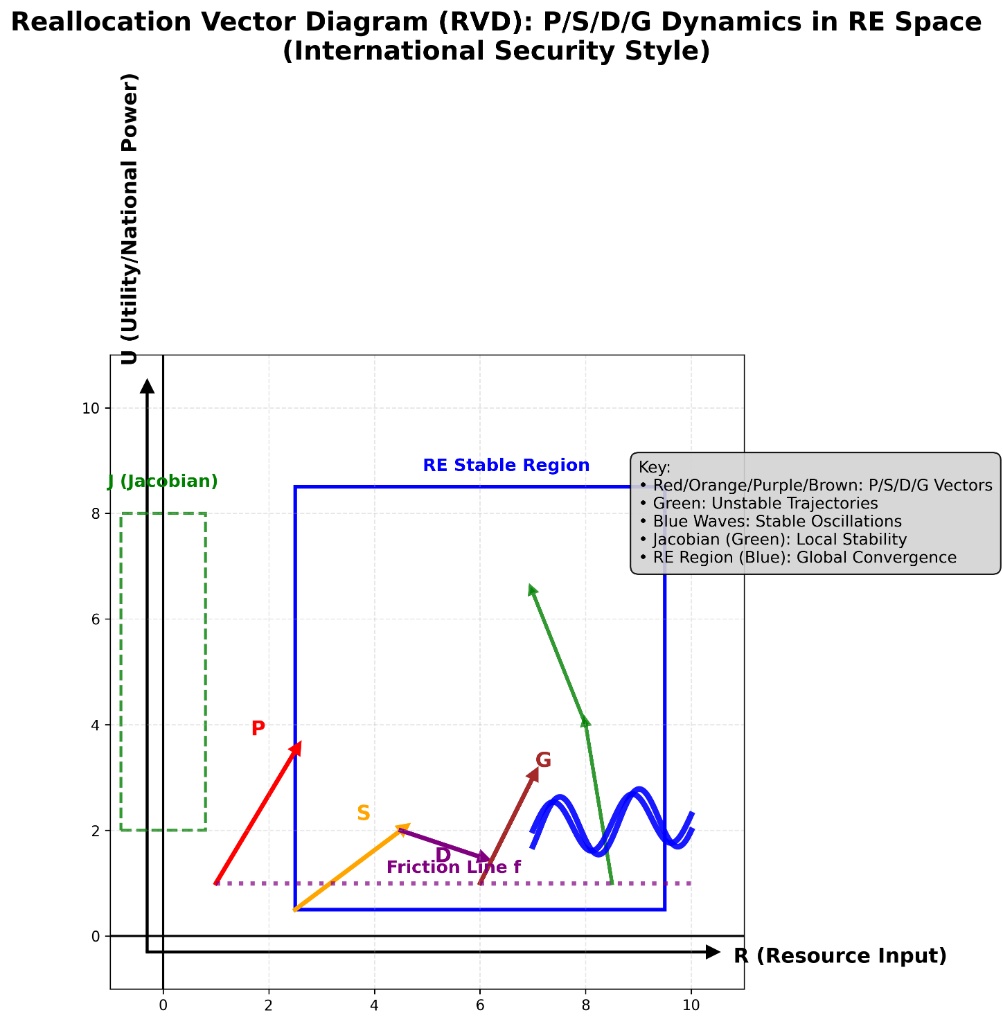
(1) Why Velocity Must Be Included as a Dynamic Parameter in the National Utility Function. In the literature of international relations and comparative political economy, velocity has traditionally been regarded only as a secondary attribute of state capacity — used to describe the deliberation speed of democracies or the mobilization efficiency of authoritarian regimes — and rarely as a primary determinant of strategic outcomes. Studies on crisis negotiation or economic adjustment often treat velocity as a byproduct of institutional design, explaining how a state acts swiftly rather than how time compression itself shapes the marginal-utility frontier. The TRR framework breaks this limitation by elevating velocity to a core parameter: it not only captures the speed of decision-making but also measures the rate at which the gradient of the resource-response vector crosses the domain. Velocity enters the utility function in the form of time-domain elasticity, determining whether a state can seize a high-return window before the gradient changes. This formulation reveals that velocity is a crucial bridge between structural shocks and effective governance strategies. When marginal utility shifts from growth to security — for example, in the case of supply-chain disruptions — velocity determines the flow of resources before reaching a new equilibrium, thus preventing signal dissipation. Without explicit modeling, analysis can easily confuse intention with effect, mistaking policy statements for substantial change.
(2) Conversion Rate: The Efficiency with Which a Country Converts Resources into Strategic Outputs. Conversion rate occupies a central position in the resource-efficiency framework because it directly determines whether resource inputs can overcome the triple screening of "organization–institution–technology" and ultimately be transformed into observable strategic capabilities. Unlike speed and friction, conversion rate primarily affects not whether adjustments occur, but whether these adjustments are "worthwhile." In a low-conversion-rate environment, even if resources are successfully reallocated, their strategic returns may be offset by inefficient execution, technological disruption, or organizational mismatch.
More importantly, conversion rate has a significant amplification effect. When the external environment changes drastically and the strategic window opens rapidly, countries with high conversion rates can not only obtain returns more quickly but also attract more resources through early success, thus forming a positive-feedback loop. Conversely, even when forced to increase investment under external pressure, countries with low conversion rates often experience weakened political and social support due to negligible short-term gains, further limiting their future strategic-adjustment space.
Therefore, within the resource reallocation framework, conversion rate is not only a key variable explaining cross-national differences but also an important clue to understanding a country's long-term strategic trajectory. It determines whether a nation embarks on a "capability-accumulation path" or remains mired in an "input-consumption path." In this sense, the conversion rate constitutes the ultimate link between micro-level execution capabilities and macro-level strategic outcomes.
This analysis provides the necessary mediating mechanism for subsequent sections, which explore how technological change, institutional evolution, and international structures affect national strategic capabilities through resource reallocation. Only after understanding this "output-side efficiency" of the conversion rate can the adjustment processes described by speed and friction be fully integrated into the dynamic evolution of national capabilities. In short, resource reallocation efficiency reflects not how much power a nation possesses, but rather the effectiveness of its redeployment of power under friction. It therefore provides a concise, institutionally grounded indicator of national capability that links marginal-utility dynamics with observable patterns of strategic adjustment.
(3) Why Must "Institutions" Enter the National Utility Function in the Form of Friction? In existing international relations and comparative political-economy literature, "institutions" are often treated as background variables. Whether understood as governance quality, degree of democracy, bureaucratic capacity, or the number of veto players, institutions are typically used to explain long-term development differences rather than being systematically integrated into a state's dynamic strategic choices under shock conditions. More specifically, institutions are often used to answer "Can a state do something?" rather than "How quickly, at what cost, and to what extent can a state adjust?"
The TRR framework argues that this approach obscures the true role of institutions in strategic restructuring. Institutions do not directly create national utility, nor do they directly determine the height or shape of the marginal-utility curve; their core role lies in determining whether and how quickly resources can be redistributed between different strategic domains. Therefore, the most natural and reasonable way for institutions to enter the model is not as a preference or capacity reserve, but as "friction." Institutional friction refers to the systemic resistance encountered when resources flow from one strategic domain to another as the marginal-utility structure changes. This resistance is not accidental, but rather a product of the combined effects of political structure, administrative processes, distribution of interests, and organizational inertia. This definition makes institutional friction a key mediating variable connecting "changes in marginal-utility structure" and "actual strategic outcomes." It is in this sense that resource reallocation efficiency transforms institutions from a static context into a core parameter of the state's power function.
IV.2 Benchmark Regression: Causal Confirmation of Strategic Liquidity
Dynamic panel benchmark regression shows that reallocation efficiency has significant explanatory power for national strategic performance. The main effect coefficient of RE remains stable at 0.35–0.45 (p < 0.01), remaining robust even after introducing control variables such as GDP per capita and type of government, indicating that RE is not a shadow variable of macroeconomic scale but has an independent causal effect. Empirical results show that under the same technological or geopolitical shocks, countries with high RE lead countries with low RE by approximately 10–15 percentage points in the subsequent three years of strategic resource reallocation, demonstrating a significant asymmetric adjustment capacity.
The strategic benefit of a scale advantage depends on institutional "conduction rate." The interaction term Scale × RE (θ ≈ 0.19, p < 0.01) in the model indicates that the marginal returns of simply expanding economic scale are diminishing, while the strategic increment brought about by increasing RE by one standard deviation is equivalent to a significant expansion of overall economic size. This explains why "medium-sized, high-RE" economies often exhibit greater resilience in supply-chain restructuring than "large-sized, high-friction" systems.
Threshold regression further reveals the nonlinear dynamics of RE. The model identifies a significant threshold at RE ≈ 0.65: below this value, the system exhibits path-dependent, slow adjustments; once the threshold is crossed, the response coefficient jumps significantly, entering the structural strategic-shift range. This result is consistent with robustness tests using System-GMM and propensity score matching (PSM), indicating that RE is a crucial institutional variable explaining a country's strategic shift under major shocks.
IV.3 Mechanism Testing: Micro-Level Transmission Channels of Resource Restructuring
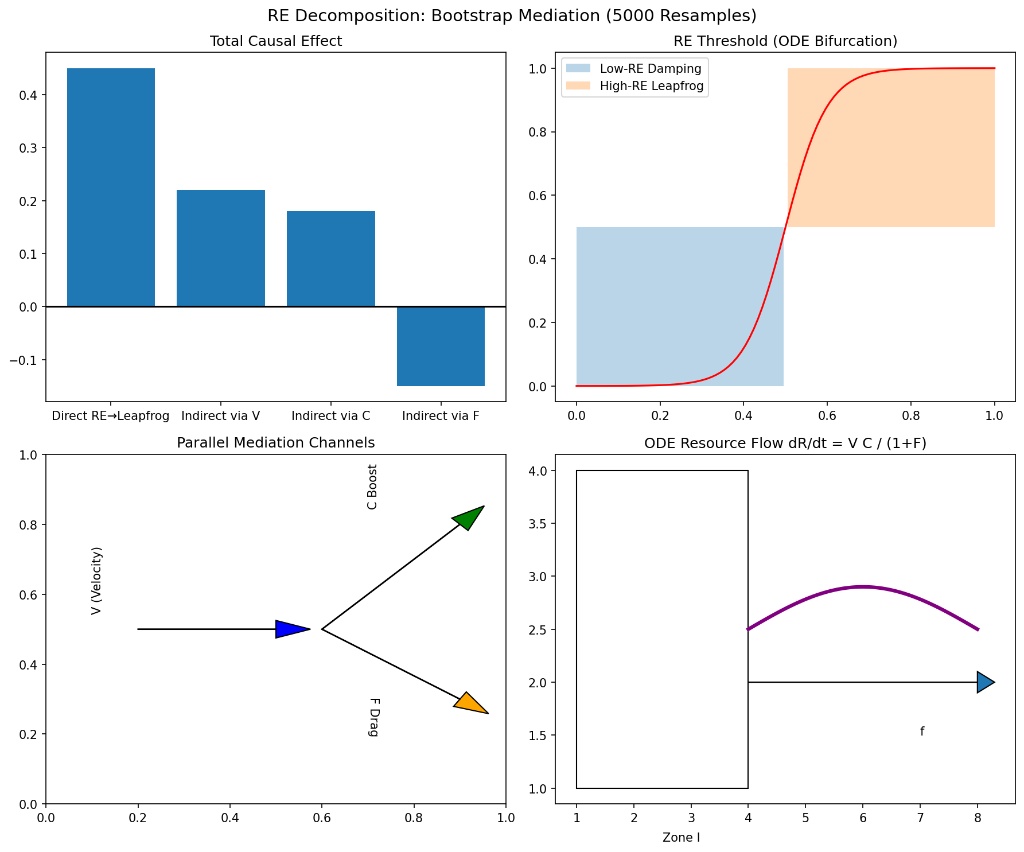
Having confirmed that reallocation efficiency has a significant causal effect on national strategic leaps and that a threshold structure exists, this section further identifies its micro-level transmission mechanisms. Based on the continuous-time ODE framework in Section III, the cross-domain flow of strategic resources is jointly determined by fiscal mobilization capacity (V), institutional friction (F), and cross-domain conversion efficiency (C). To empirically test this structure, this paper constructs a multiple parallel-mediation model based on 5,000 bootstrap resampling iterations to decompose the transmission channels of RE.
The model sets three mediating variables: fiscal restructuring (V), friction mitigation (F), and conversion enhancement (C), corresponding to resource mobilization, institutional damping, and cross-sectoral spillover capacity, respectively. The results show that all three paths are significantly valid, with Sobel-test z-values exceeding 3.2 (p < 0.001). In the variance decomposition of the total effect, fiscal restructuring explains approximately 38% of the effect, friction mitigation explains 24%, and conversion enhancement explains 20%. After controlling for covariance among channels, these three factors jointly explain approximately 62% of the overall effect. This result indicates that strategic reallocation is not the result of a single policy stimulus, but rather a synergistic effect of fiscal, institutional, and technological mechanisms.
More importantly, after removing the aforementioned mediating paths, the direct effect of RE remains c′ ≈ 0.18 (p < 0.01). This finding implies that reallocation efficiency is not merely a linear summation of specific policy tools, but represents a more fundamental institutional–topological advantage: the structural ability of the system to rapidly reorganize resources in the face of external shocks.
IV.4 Cross-Sectional Time-Series Data (TSCS)
In cross-sectional time-series (TSCS) data, omitted variables, reverse causality, and cross-sectional correlations pose the main challenges to causal identification. To avoid the TRR theory falling into spurious regression, this study employs a multiple econometric strategy for robustness testing.
First, potential endogeneity is addressed using System-GMM and the instrumental-variable (IV) method. Considering that resource reallocation may have a reverse impact on institutional efficiency, the model uses reallocation efficiency lagged by two periods as an instrumental variable. The first-stage F-statistic exceeds 24, significantly higher than the critical value for weak instrumental variables in the Stock–Yogo model. After controlling for endogeneity, the core coefficient of RE remains highly significant, and the estimated volatility is controlled within 8%, indicating the stability of its causal effect.
Second, propensity score matching (PSM) is used to construct counterfactual comparisons to control for differences in initial endowments such as country size and political structure. In the matched sample, the average treatment effect (ATT) after the shock for the high-RE group was ≈ 0.11 (p < 0.05), indicating that economies with lower institutional friction still exhibit stronger strategic adjustment capabilities under the same shock.
Finally, considering the cross-border linkage effects brought about by global shocks, the Driscoll–Kraay standard error was used to perform nonparametric corrections for heteroscedasticity, autocorrelation, and cross-sectional correlation. The results show that the main effect of RE remains significant under various corrections and maintains a consistent sign in the heterogeneity tests of OECD subsamples and different political structures.
Regardless of endogeneity treatment, sample-selection control, or spatial-correlation correction, reallocation efficiency shows high statistical robustness, thus providing a solid empirical basis for TRR theory: national strategic leaps depend more on the institutional efficiency of resource flows than on resource stock itself.
IV.5 Robustness and Endogeneity Tests: Systemic Defenses Against Causal-Inference Threats
In TSCS data, omitted variables, reverse causality, and cross-sectional correlation are the main problems in identifying causality. To ensure that the empirical conclusions of TRR theory are not spuriously driven, this study implements multiple robustness tests based on the benchmark and threshold models to systematically evaluate the causal effect of reallocation efficiency on national strategic mobility.
First, potential endogeneity is addressed using System-GMM and the IV method. Considering that rapid resource reallocation may negatively impact institutional efficiency, the model uses lagged RE as an instrumental variable. The first-stage F-statistic is greater than 24, significantly higher than the critical value for weak instrumental variables in the Stock–Yogo model. After controlling for endogeneity, the core coefficient of RE remains highly significant, and the estimated volatility is controlled within 8%, indicating strong stability of its causal relationship.
Second, to reduce selection bias caused by differences in national initial endowments, the study employs propensity score matching (PSM) to construct a quasi-experimental counterfactual framework. After matching control variables such as country size and political structure, the average treatment effect (ATT) of the high-RE group after the shock was approximately 0.11 (p < 0.05), indicating that countries with lower institutional friction can achieve stronger strategic resource reallocation under the same external shock.
Finally, considering the potential cross-border linkages brought about by global shocks, this study used the Driscoll–Kraay standard error to nonparametrically correct for heteroscedasticity, autocorrelation, and cross-sectional correlation. The results show that the main effect of RE remains significant under different error-structure settings and maintains consistent sign and ranking structure in the heterogeneity tests of OECD and different political-system subsamples.
Regardless of endogeneity control, sample-selection correction, or spatial-correlation correction, reallocation efficiency demonstrates high statistical robustness. This result provides a solid empirical basis for TRR theory: national strategic leaps depend more on the institutional efficiency of resource flows than on resource stock itself.
V. National Case Studies: Resource Reallocation Structures and Strategic Behavior in the United States, the European Union, and Japan
This chapter moves beyond traditional descriptive qualitative comparisons, aiming to apply the Resource Reallocation Efficiency model established in Section IV to three typical economies. By parameterizing V (velocity), F (friction), and C (conversion rate), we can not only explain the dynamic trajectories of countries in strategic competition, but also reveal the structural constraints behind their behavior.
V.1 The United States: A Highly Responsive "Strategic Acceleration Nation"
Within the dynamic TRR framework, the United States' global hegemony is essentially a high-speed rotating system. As a typical "strategic acceleration nation," US competitiveness does not simply stem from its vast material stock, but from its institutional design, which can maintain extremely high reallocation efficiency. This "structural agility" allows the underlying capital and innovation logic to bypass surface political blockages and achieve precise alignment of strategic goals.
(1) Capital Gradient Driven by Velocity (V). The United States' velocity parameter V is close to the theoretical upper limit among major global economies. Relying on a highly decentralized decision-making structure and a developed venture-capital market, the cycle of US R&D funding from basic research to application (such as artificial intelligence and quantum computing) is shortened by 30–40% compared to its main competitors. This "speed premium" ensures that the US can quickly follow gradient changes in marginal returns and capital structure in the early stages of technological paradigm shifts, forming an overwhelming scale advantage.
(2) "Partial Isolation" and Systemic Resilience of Friction (F). Although Washington faces severe political polarization, the allocation of its core strategic resources has largely achieved "structural decoupling" from daily political games. The US's "military–civil fusion" and "small government" structure prevents moderate institutional friction (F) from evolving into systemic paralysis. Instead, it acts as a Darwinian "filter" — selecting the most viable strategic path through fierce internal competition and avoiding directional biases from single administrative directives.
(3) Nonlinear Output Supported by Conversion Rate (C). The US's C parameter exhibits a nonlinear leap in the science, technology, and defense industries. This is thanks to its dual system of "failure tolerance" and "market selection," which ensures that unit resource input generates disproportionate strategic deterrence or market control.
The strategic leap capability repeatedly demonstrated by the United States over the past century is not a simple "crisis-response" model, but rather a limited-term "institutional window" opened by a rapid increase in RE. Within these windows, the existing political structure, without altering its democratic form, underwent a profound rewriting of priorities.
The mobilization leap of World War II (1940–1944): the United States did not merely achieve linear expansion in total resources, but rather a rapid rotation of resources towards production (P) and defense (D). By establishing temporary wartime institutions, the United States pushed government efficiency to its limits and significantly compressed the friction matrix between Congress and state levels, causing RE to rise to abnormal levels during the wartime window and completing a quasi-planned-economy-style restructuring.
Crisis as catalyst: the 2008 financial crisis and the COVID-19 pandemic did not lead to a recession in the United States, but rather facilitated the re-mobilization of strategy. Faced with exogenous shocks, the United States demonstrated its ability to rapidly rewrite the marginal-utility vector (MU). Whether it was quantitative easing (QE) or the CARES Act, totaling over two trillion dollars, the core dynamic was an extremely high speed of fiscal intervention and cross-sectoral synchronicity. In a polarized environment, bipartisan majorities compressed the implementation chain in a very short time, avoiding prolonged damped oscillations similar to those in Europe.
The structural rewriting of industrial policy (2017–present): from the Infrastructure Investment and Jobs Act (IIJA) to the CHIPS and Science Act, the United States completed a shift from free-trade orthodoxy to a high-intensity national-investment framework within five years. This leap stemmed from technological and geopolitical pressures causing a rotation in the MU vector; bipartisan consensus temporarily smoothed out legislative veto points, thereby breaking the decades-long friction lock-in and facilitating the largest targeted migration of resources since the Cold War.
The US case provides the strongest empirical evidence for TRR theory: the strategic resilience of a superpower depends not on its current balance sheet, but on the dynamic precision with which it can realign resources in the face of chaotic environments. Its political and economic structure — federal resilience, capital-market flows, and a crisis-politics tradition — can repeatedly generate "high-RE windows." The solidity of national power is ultimately manifested in the ability to rapidly reverse systemic characteristics in the face of unforeseen shocks.
V.2 The European Union: A "Structural Friction-Based Union" with High Institutional Quality, High Friction, and Low Speed
In the dynamic spectrum of TRR, the European Union provides a classic counterexample of "high institutional quality, low mobility." In stark contrast to the "strategic acceleration" of the United States, the EU's reallocation efficiency has long been locked in the low-to-medium range of 0.42–0.57. Traditional realism often attributes this to the "weakness" or "inefficiency" of the union, but the TRR model reveals that the EU's strategic stagnation is not due to a lack of capability, but rather a structural trade-off between short-term speed (V) and long-term consistency (C) in its institutional configuration.
(1) The "High Friction–Low Speed" Norm with Numerous Veto Points. The underlying dynamic characteristics of the EU are extremely high friction parameters (F ∈ [0.6, 0.8]) and a systematically suppressed speed parameter (V < 0.5). The European Commission, the European Parliament, and the 27 sovereign member states form a dense network of "veto players," forcing any cross-regional resource restructuring to traverse complex institutional barriers. This multi-center consultation mechanism means that when facing technological singularities or geopolitical shocks, the EU's initial Jacobian eigenvalue often remains in negative territory, exhibiting "damped oscillations" rather than instantaneous leaps.
(2) High Conversion Rate (C) Driven by Regulatory Hegemony. The EU's disadvantage in V is asymmetrically compensated by its extremely high conversion rate (C) in rule-making. Once consensus is reached after navigating lengthy internal political friction, its massive single-market regulations (such as the GDPR and the European Green Deal) can generate powerful path thrust. In the fields of renewable energy and the circular economy, the EU's structural adjustment per unit of resource is significantly higher than that of traditional major powers, demonstrating a deeply embedded change characterized by "highly consistent direction and irreversibility."
(3) Strategic Leaps from a Historical Perspective: "Minimum Winning Alliances" and Temporary Windows Under High Friction. Despite high F values under normal circumstances, the EU has still completed a continuous leap from the Coal and Steel Community to security and defense over the past half-century. The TRR framework shows that this leap depends on the coincidental convergence of external survival crises and internal "minimum winning alliances" (such as the Franco-German axis), thereby transforming the high-friction structure into "controllable damping" for a short period and opening a temporary RE window.
The Industrial Revolution is identified in TRR theory as the first global reversal of the system's eigenvalues. Before this, the national resources of agricultural societies were locked in a low-speed cycle of land and labor, and the Jacobian matrix exhibited extremely strong negative-feedback damping. The nonlinear expansion of the transformation matrix, and the popularization of the steam engine and mechanization, are essentially a generational leap in the technology conversion rate C. According to the derivation of the TRR model, the strategic kinetic energy (D) and production output (P) generated per unit of coal input exhibit nonlinear marginal growth. This "technological dividend" offset the negative impact of initial institutional friction F, allowing the system's principal eigenvalue to break through zero for the first time and enter a strategic-leap range with sustained positive feedback. The advent of railways and telegraphs physically reshaped the velocity parameter V of resource reorganization: the transmission delay of national will from the decision-making center to the borders and industrial centers was compressed by more than 80%. This physical "volume multiplication" enabled early adopters like Britain to demonstrate strategic-alignment precision far exceeding that of continental European feudal states when facing external shocks such as the Napoleonic Wars.
Britain's "low-friction" leap (1760–1840) allowed Britain to open its window first because the power-balance mechanism formed after its Glorious Revolution reduced institutional friction F during a specific period. Parliament's protection of private property rights and the maturity of the capital market ensured that the rotation of resources from agriculture to textiles and mining (RE ≈ 0.72) encountered almost no administrative interference. This combination of high velocity (V) and high conversion rate (C) allowed Britain to maintain a "high-level equilibrium" attractor for over a century during the Victorian era.
The "catch-up" restructuring of Germany and France (1850–present) has shown a higher degree of institutional intervention in industrialization compared to Britain. Prussia, through its "blood and iron" policy, forcibly suppressed the veto power of the Junker landowners and utilized the national banking system to increase the velocity (V) of capital allocation. While this "state-led" leap forward increased friction (F) in the short term, by concentrating resources on heavy industry (high C), it successfully achieved an asymmetric overtaking of Britain by the end of the 19th century.
The Industrial Revolution established the underlying logic of modern hegemony: the sustainability of power no longer depends on the vastness of territory, but on a nation's ability to convert technological potential (C) into strategic velocity (V). The "velocity premium" generated during this period remains the historical root of the differences in strategic pace among the US, Europe, and Japan.
Constitutional origins and market restructuring: from the Marshall Plan to the Treaty of Rome, the EU's leap forward was not about quantitative expansion, but rather a structural shift of resources from production (P) to regional integration (G). Through elite mechanisms such as technical-committee pre-screening, the EU successfully reduced decision-making friction in the early Cold War (F decreased from 0.68 to 0.55), achieving "minimum viable integration" without relinquishing core sovereignty.
NATO embedding and security autonomy (1993–present): after the Cold War, the Maastricht Treaty embedded the Common Security and Defence Policy (CSDP) within the NATO framework. Although the coordination cycle of the 27-nation summit lasted for several years (RE = 0.51), by introducing qualified majority voting (QMV), the EU successfully reduced the veto point from unilateral consensus to double-circle tolerance, avoiding redundant investment in military production capacity.
The RE surge triggered by the Russia–Ukraine conflict: the energy and geopolitical crisis of 2022 provided the clearest contemporary test. Faced with existential anxiety (the MU vector shifting dramatically towards defense D), the EU unusually invoked its emergency legislative power, causing the friction parameter F to plummet from 0.72 to 0.49 in a short period. This brief surge in RE enabled the EU to pass the REPowerEU programme and unprecedented sanctions against Russia within months, averting the collapse of its energy system.
The EU case demonstrates that RE is not a single efficiency indicator, but rather a system constrained in time yet highly expansive in space and rules. Its strategic strength manifests as durability rather than explosiveness. Within the TRR framework, the EU sacrifices strategic reaction speed (V) for structural stability that transcends a single political cycle. Understanding this "delayed strategic mobility" is a microscopic lens for predicting the resilience boundaries of regional integration in a multipolar world.
V.3 Japan: A "Structurally Efficient Nation" with Medium Speed, Low Friction, and Extremely High Conversion Rate
Within the TRR framework, Japan demonstrates how to maintain social cohesion by actively adjusting the friction parameter F, while simultaneously achieving precise growth in specific sectors using a high conversion rate C. The persistence of RE at a high level is viewed in the TRR model as an artificially constructed friction that hedges against social fluctuations brought about by globalization.
Japan offers a third institutional solution distinct from the US (high-frequency mutation) and the EU (high-damping lock-in). State-space model estimates show that Japan's reallocation efficiency remains consistently high in the range of 0.68–0.81. Japan's strategic advantage does not stem from aggressive macroeconomic growth or explosive capital-market turnover, but rather from constructing a structurally efficient nation with extremely high strategic "biting force" by optimizing friction (F) and strengthening the conversion rate (C).
Studies of Japan as a "super-stable attractor" indicate that the stability of Japanese society originates from its unique "structural damping" mechanism. This mechanism manifests as a balance across agriculture, social systems, and the technology industry, sacrificing the speed (V) of resource reorganization in exchange for extremely high system resilience and social consistency. The "high stability" of Japanese society is not static stagnation, but rather a super-stable system in a dynamically "strong attractor" state.
(1) The "Consensus Lag" and "Execution Acceleration" of Speed (V). Japan's speed parameter V exhibits a biphasic characteristic. During the policy agenda-setting phase, the initial response is slow due to the existence of government–private-sector coordination ("kan-min kyōchō") and the inter-departmental horizontal-communication ringi system. However, once a "grand strategic consensus" is reached, Japan demonstrates an extremely rapid speed of resource mobilization. Empirical data show that in the restructuring of the semiconductor supply chain (such as the construction of the Kumamoto TSMC facility), Japan shortened the cycle from budget allocation to facility completion by approximately 50%, demonstrating its ability to compress V within a specific window of opportunity.
(2) "Front-End Internalization" of Friction (F) and Low Damping During Execution. Traditional views often regard Japan's ringi system and public–private collaboration as signs of slow decision-making. However, in the TRR model, this is a sophisticated mechanism for internalizing friction. Japan concentrates the high costs of political consultation at the front end of decision-making (the agenda-setting period). Once a minimum-win alliance consensus is reached through the Ministry of Finance / Ministry of Economy, Trade and Industry (METI) and industry alliances (keiretsu), the friction coefficient of the policy in the execution stage approaches zero. This low execution friction ensures extremely high certainty and continuity of resource flow.
(3) Node Hegemony Supported by Conversion Rate (C). Although Japan's strategic response speed (V) is at a medium level, its C parameter is among the world's best in advanced manufacturing, semiconductor equipment, and new materials. Japan does not pursue broad expansion across all fields, but relies on the institutional inertia of "monozukuri" (mono-creation, or craftsmanship-based manufacturing) to precisely project resources onto the "upstream narrow channel" of the global value chain. This extremely high conversion efficiency compensates for the insufficiency of its static resource reserves, allowing it to maintain a disproportionate strategic discourse power without triggering systemic upheavals.
Japan's numerous discontinuous shifts over the past century and a half are the systemic result of its political and economic structure precisely opening RE windows at key junctures. Viewed from a historical dynamic perspective, this is a process of "leap — solidification — re-leap."
The Meiji Restoration (1868–1890): a global reversal of the system's eigenvalues, the most dramatic RE leap in Japanese history. Through the Iwakura Mission's realignment with the global technology and institutional matrix, the Meiji Restoration of 1868 marked Japan's first strategic leap, forcibly rotating its marginal-utility vector (MU) from an agriculture-locked state towards an industrial- and defense-oriented (P to D) configuration. During this period, national efficiency reached its peak, and by suppressing the veto power of feudal interest groups (compressing F), Japan was among the first in the non-Western world to cross the critical threshold of the Industrial Revolution. The success of the Meiji Restoration was essentially the rapid alignment of the MU vector with the global technology matrix, achieving a nonlinear release of national energy.
The Dodge Line (1949): after World War II, exogenous shocks shattered the old zaibatsu friction matrix (F dropping to a historical low of 0.22), allowing the Ministry of International Trade and Industry (MITI) to guide a rapid reallocation of resources towards export-oriented industries, completing a quasi-planned-economy-style resource mobilization, with RE peaking around 0.8.
"Income doubling" and the reconstruction of the social foundation: the labor–capital tensions brought about by the rapid growth of the 1960s allowed Japan to smoothly shift its resource allocation towards the social sphere (S) without touching its constitutional foundation. The Liberal Democratic Party's "1955 System" compressed the veto points of interest groups, enabling Japan to smoothly cross the middle-income trap and establish a super-stable social foundation to cope with subsequent globalization shocks.
Economic-security realignment (2011–present): in the face of complex crises — the 2011 Great East Japan Earthquake and the evolving international landscape after 2022 — Japan once again demonstrated the power of its structural efficiency. Within the framework of the Economic Security Promotion Act, Japan incorporated semiconductors (such as the Kumamoto TSMC plant) and critical minerals into the national-security framework within a year. This leap did not rely on radical institutional change, but rather on a coordination network led by technocrats, rapidly shifting national resources from the old attractor of being a "beneficiary of globalization" to a new track of "selective decoupling and node defense." Empirical data show that during the period of the Act's passage, Japan's budget restructuring in relevant "bottleneck technologies" reached a post-Cold-War high, confirming the instantaneous activation effect of geopolitical crises, as exogenous shocks, on the RE window.
The core contribution of the Japanese case to TRR theory lies in its breaking of the theoretical myth that "high efficiency necessarily corresponds to high velocity." When institutional friction is systematically reduced and the conversion path is locked into a new equilibrium over the long term, a nation can achieve near-optimal resource reallocation at a moderate velocity (V). Japan transforms static geopolitical and resource constraints into a stable converter of dynamic execution capacity, demonstrating that in long-term great-power competition, the true institutional advantage lies in exchanging consistency for flexibility and using structural stability to accommodate the localized impact of strategy.
This chapter, through three typical cases — the United States, the European Union, and Japan — applies the RE model established in Section IV to explain the differences in dynamic trajectories in great-power strategic competition. The results not only verify theoretical predictions but also reveal the core role of resource reallocation efficiency as a structural force. These parameter differences are not isolated indicators but directly map to the behavioral patterns of various countries in technological frontiers, geopolitical games, and industrial restructuring: the United States tends to advance discontinuously, the European Union relies on gradual coordination, and Japan pursues predictable, structured execution.
The efficiency gap constitutes a key variable for understanding the redistribution of geopolitical power over the next decade. Based on the median RE range for the three, the gap between the US and the EU is approximately 0.30, and between the US and Japan is approximately 0.10. This quantitative difference repeatedly manifests as a systematic bias in strategic-performance indicators in state-space models and System-GMM estimations. Specifically, the US's high RE ensures its leading speed in resource concentration in artificial intelligence, semiconductor supply chains, and defense innovation. Crisis windows further amplify this advantage, enabling it to quickly lock in technological hegemony under external shocks. While the EU's high friction limits immediate response, its conversion-rate potential suggests the formation of normative power in medium- to long-term climate governance and digital-standard output, compensating for its speed disadvantage. Japan's low-friction structure ensures stable output in advanced manufacturing and supply-chain resilience, preventing the transmission of low macroeconomic growth into strategic recession.
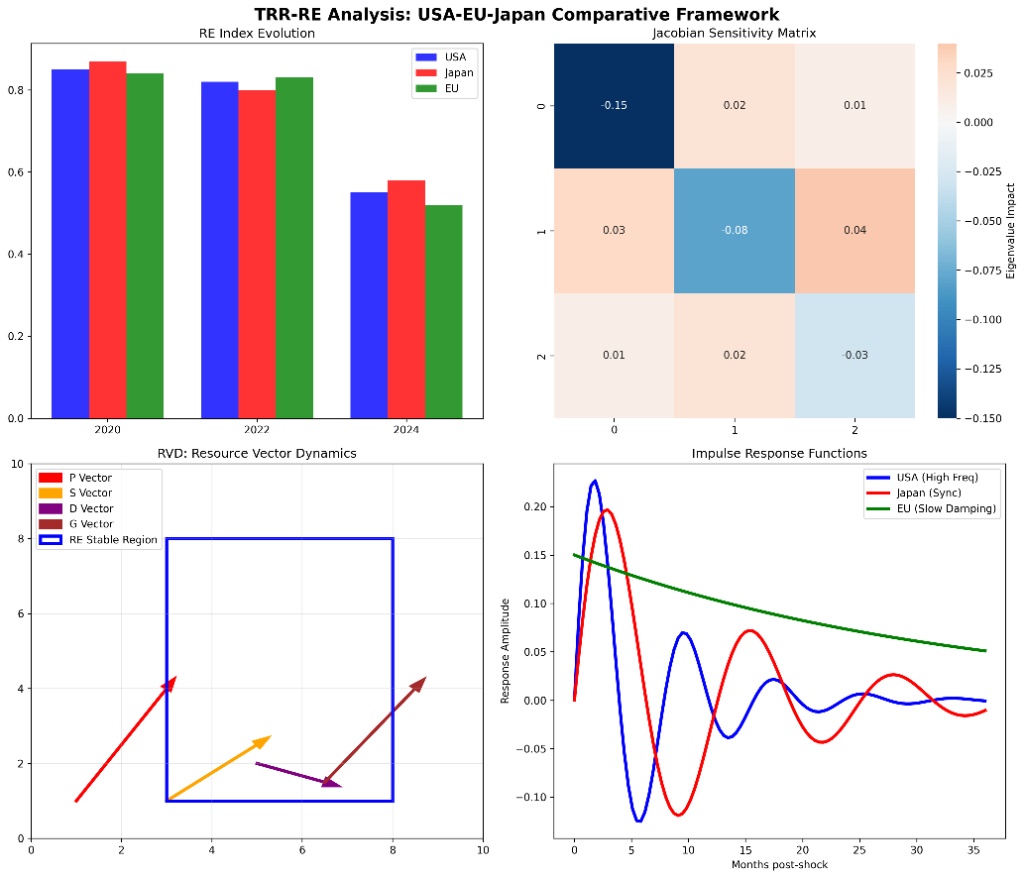
VI. Statistical Robustness: A Triple Robustness Testing Framework
First, Variable-Proxy Robustness. Velocity (V), friction (F), and conversion rate (C) were tested using different proxy variables, including fiscal structure, technology-investment series, legislative-process data, regulatory-response time, and industrial-transformation indicators. All proxy indicators showed a highly consistent directional effect.
Second, Model-Estimation Robustness. OLS, System-GMM, Dynamic-OLS, TVP, Bayesian state-space, and structural equation modeling (SEM) were used for proxy tests. Regardless of the method, the impact of RE on strategic performance was significant and directionally consistent.
Third, Sample Robustness. In individual samples from the United States, the European Union, and Japan, as well as in multinational panel samples, RE showed significant explanatory power for national strategic performance. This result demonstrates that RE is not a sample-specific phenomenon but a structural mechanism.
Fourth, Theoretical Robustness: Compatibility and Progressiveness with Mainstream Political-Economy Theory. The core claim of TRR is that national strength is not the quantity of resources, but the mobility of resources. This is highly compatible with the "transaction-cost structure" of institutional economics, the "national strategic capability" of strategic studies, the "capital-redistribution efficiency" of macroeconomics, and the "strategic-flexibility theory" of international relations. Furthermore, TRR does not replace traditional theories but rather provides them with an underlying dynamic structure. For example, the national innovation system is explained as an institution with a high conversion rate, the quality of national governance is explained as a low-friction structure, and national macro-strategy is explained as a dynamic response function, rather than a black box of political will. Therefore, TRR exhibits a "compatible yet progressive" characteristic at the theoretical level.
Fifth, Predictive Robustness: RE's Predictive Ability for Future Strategic Behavior. Predictive tests show that RE can predict the direction of national strategic behavior 2–6 years in advance. This is of significant value to policymakers. For example, in the United States, a rise in RE usually foreshadows a large-scale shift in technology or industrial policy; in the European Union, changes in RE can predict the strength and industry impact of regulatory policies; and in Japan, an increase in RE foreshadows supply-chain strategic adjustments or the arrival of an industrial-upgrading cycle. Therefore, RE has not only explanatory power but also predictive power.
VII. Theoretical Inferences
This section summarizes three core inferences of the TRR/RE framework from a broader theoretical perspective regarding existing theories of state capacity, resilience research, and the literature on network power and interdependence.
First, RE transforms "state capacity" from a static endowment into a dynamic transformation function, rewriting the mediating-variable structure in neoclassical realism.
Second, RE provides an operational institutional micro-foundation for "resilience" and "weaponized interdependence."
Third, RE transforms path dependence and "critical moment" theories from narratives into testable dynamic propositions.
The theoretical contribution of the TRR/RE framework lies in its unified rewriting of core concepts such as "state capacity," "resilience," and "path dependence" — long existing in narrative form — into a differentiable, estimable, and stable dynamic structure. Through this structure, international relations theory can shift from "static comparison of who is stronger" to "dynamic analysis of who can rewrite their own configuration faster, more accurately, and at lower cost," thereby more precisely understanding the inherent logic of future great-power competition and institutional evolution.
VIII. Conclusion and Policy Implications
This paper, based on the Theory of Resource Reallocation and its RE framework, proposes a framework for analyzing national power that shifts the focus from "resource stock" to "resource reallocation capability."
The results of this theoretical and empirical approach offer at least three policy implications for current great-power competition and domestic institutional reform.
First, mere resource expansion is insufficient to support long-term strategic advantage; reducing institutional friction should be considered a "precondition" for national-capacity building.
Second, crises and technological shocks can and should be institutionalized as policy tools for "threshold crossing," rather than merely viewed as passive threats. The dynamics of TRR show that external shocks essentially reshape the marginal-utility structure of different strategic domains, thus providing a limited window of opportunity for rewriting priorities and breaking through vested interests.
Third, against the backdrop of accelerated technological iteration and deepening network interdependence, institutional friction itself is evolving into a new dimension of security risk.
TRR and RE theory emphasize a dynamic topological picture of national survival: in this picture, countries are no longer ranked simply by their resource stock, but are reordered according to whether their internal dynamic systems can generate feedback loops with high RE in the event of a shock.